Wednesday, September 7, 2016


Wednesday, September 9, 2015
The Morning Reading: "Summer seemed to bloom against the will of the sun"
 |
| John Crawford. |
- Jericho Brown
Aster. Nasturtium. Delphinium. We thought
Fingers in dirt meant it was our dirt, learning
Names in heat, in elements classical
Philosophers said could change us. Star Gazer.
Foxglove. Summer seemed to bloom against the will
Of the sun, which news reports claimed flamed hotter
On this planet than when our dead fathers
Wiped sweat from their necks. Cosmos. Baby’s Breath.
Men like me and my brothers filmed what we
Planted for proof we existed before
Too late, sped the video to see blossoms
Brought in seconds, colors you expect in poems
Where the world ends, everything cut down.
John Crawford. Eric Garner. Mike Brown.
Aster. Nasturtium. Delphinium. We thought
Fingers in dirt meant it was our dirt, learning
Names in heat, in elements classical
Philosophers said could change us. Star Gazer.
Foxglove. Summer seemed to bloom against the will
Of the sun, which news reports claimed flamed hotter
On this planet than when our dead fathers
Wiped sweat from their necks. Cosmos. Baby’s Breath.
Men like me and my brothers filmed what we
Planted for proof we existed before
Too late, sped the video to see blossoms
Brought in seconds, colors you expect in poems
Where the world ends, everything cut down.
John Crawford. Eric Garner. Mike Brown.
*
(thanks to Kazim Ali for bringing this one to me.)
Monday, August 17, 2015
The Morning Reading: "I don't mind standing a little longer"
 |
| Julian Bond, 1940-2015 |
I TOO, HEAR AMERICA SINGING
- Julian Bond
[As published in the first issue of The Student Voice — SNCC's newsletter, summer, 1960.]
I too, hear America singing
But from where I stand
I can only hear Little Richard
And Fats Domino.
But sometimes
I hear Ray Charles
Drowning in his own tears
or Bird
Relaxing at Camarillo
Or Horace Silver doodling,
Then I don't mind standing
a little longer.
*
SNCC = Student Nonviolent Coordinating Committee
In the New York Times:
*
Sunday, August 16, 2015
Victoria Patterson: "The Little Brother"

Summer is nearly over and among the many readings coming up in Orange County, residents should be especially interested in two by Victoria Patterson, who in her fourth novel, The Little Brother, returns to familiar territory. Unlike the recent Sunday New York Times reviewer, OC denizens will recognize the real life roots of Patterson's latest as one of the county's most notorious scandals, the Haidl gang rape case. Orange Coast magazine profiled Patterson in its August issue:
excerpt:
She grew up here, a daughter of privilege—with country clubs and private tennis lessons, and weekends in Catalina on a classmate’s family yacht. As a novelist and short-story writer, Patterson has spun literary gold from her insider access, but also because of her ambivalence about it.
Gilded Age New York had Edith Wharton, and contemporary Orange County has Victoria Patterson. Like Wharton, she explores social hierarchies and class prerogatives with a penetrating and critical eye. And like John O’Hara, another writer to whom she has been compared, she sees herself as a truth teller, and writes with a chip on her shoulder.
To read the rest, click here.
Check out details about her readings on the calendar to the right.
*
Friday, June 5, 2015
The Morning Reading: "this 9-times-folded red-white-striped, star-spotted-blue flag"

The Lowering
-May Swenson
The flag is folded
lengthwise, and lengthwise again,
folding toward the open edge,
so that the union of stars on the blue
field remains outward in full view;
a triangular folding is then begun
at the striped end,
by bringing the corner of the folded edge
to the open edge;
the outer point, turned inward along the open edge,
forms the next triangular fold:
the folding continued so, until the end is reached,
the final corner tucked between
the folds of the blue union,
the form of the folded flag is found to resemble that
of a 3-cornered pouch, or thick cocked hat.
Take this flag, John Glenn, instead of a friend;
instead of a brother, Edward Kennedy, take this flag;
instead of a father, Joe Kennedy, take this flag;
this flag instead of a husband, Ethel Kennedy, take this flag;
this 9-times-folded red-white-striped, star-spotted-blue flag,
tucked and pocketed neatly,
Nation, instead of a leader, take this folded flag.
Robert Kennedy, coffin without coverlet,
beside this hole in the grass,
beside your brother, John Kennedy,
in the grass,
take, instead of a country,
this folded flag;
Robert Kennedy, take this
hole in the grass.
The flag is folded
lengthwise, and lengthwise again,
folding toward the open edge,
so that the union of stars on the blue
field remains outward in full view;
a triangular folding is then begun
at the striped end,
by bringing the corner of the folded edge
to the open edge;
the outer point, turned inward along the open edge,
forms the next triangular fold:
the folding continued so, until the end is reached,
the final corner tucked between
the folds of the blue union,
the form of the folded flag is found to resemble that
of a 3-cornered pouch, or thick cocked hat.
Take this flag, John Glenn, instead of a friend;
instead of a brother, Edward Kennedy, take this flag;
instead of a father, Joe Kennedy, take this flag;
this flag instead of a husband, Ethel Kennedy, take this flag;
this 9-times-folded red-white-striped, star-spotted-blue flag,
tucked and pocketed neatly,
Nation, instead of a leader, take this folded flag.
Robert Kennedy, coffin without coverlet,
beside this hole in the grass,
beside your brother, John Kennedy,
in the grass,
take, instead of a country,
this folded flag;
Robert Kennedy, take this
hole in the grass.

*
Friday, May 15, 2015
The Morning Reading: "You are neither here nor there"
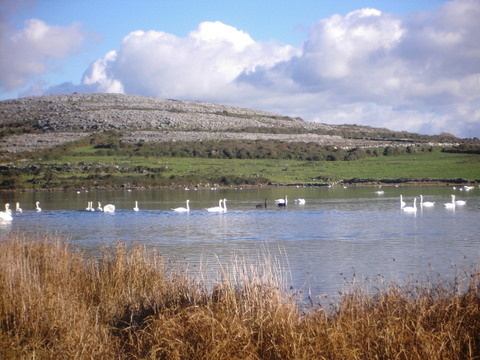 |
| http://www.clivenunn.com |
Postscript
-Seamus Heaney
And some time make the time to drive out west
Into County Clare, along the Flaggy Shore,
In September or October, when the wind
And the light are working off each other
So that the ocean on one side is wild
With foam and glitter, and inland among stones
The surface of a slate-grey lake is lit
By the earthed lightning of a flock of swans,
Their feathers roughed and ruffling, white on white,
Their fully grown headstrong-looking heads
Tucked or cresting or busy underwater.
Useless to think you'll park and capture it
More thoroughly. You are neither here nor there,
A hurry through which known and strange things pass
As big soft buffetings come at the car sideways
And catch the heart off guard and blow it open.
*
And some time make the time to drive out west
Into County Clare, along the Flaggy Shore,
In September or October, when the wind
And the light are working off each other
So that the ocean on one side is wild
With foam and glitter, and inland among stones
The surface of a slate-grey lake is lit
By the earthed lightning of a flock of swans,
Their feathers roughed and ruffling, white on white,
Their fully grown headstrong-looking heads
Tucked or cresting or busy underwater.
Useless to think you'll park and capture it
More thoroughly. You are neither here nor there,
A hurry through which known and strange things pass
As big soft buffetings come at the car sideways
And catch the heart off guard and blow it open.
*
Sunday, May 10, 2015
The Morning Reading: "All sons sleep next to mothers, then alone, then with others"

by Lisa Furmanski
All sons sleep next to mothers, then alone, then with others
Eventually, all our sons bare molars, incisors
Meanwhile, mothers are wingless things in a room of stairs
A gymnasium of bars and ropes, small arms hauling self over self
Mothers hum nonsense, driving here
and there (Here! There!) in hollow steeds, mothers reflecting
how faint reflections shiver over the road
All the deafening musts along the way
Mothers favor the moon—hook-hung and mirroring the sun—
there, in a berry bramble, calm as a stone
This is enough to wrench our hand out of his
and simply devour him, though he exceeds even the tallest grass
Every mother recalls a lullaby, and the elegy blowing through it
*
Subscribe to:
Posts (Atom)

 Posts
Posts